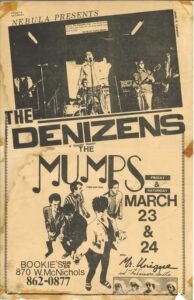
 Detroit Punk
Mike Murphy (The Denizens, the Rushlw-King Combo, the Boners, Hysteric Narcotics): No band got famous out of that whole era except the Romantics, and that’s freaky. It’s not that the Romantics weren’t Detroit, but they were not representative of that scene at all. But maybe that’s why they did get signed. When they were first working they were getting on all the good bills and paid for a rehearsal space and they were on salary, which sure isn’t like the rest of the bands. We were poor. I was working at a 7-Eleven.
Crazy Mixed Up Kids!
Detroit art and music has always been innovative and the late 70s/early 80s punk/new wave scene was no exception. This scene, based mostly around Bookie’s Club 870 starting in early 1978, deserves to be recognized for its energy & impact on the Motor City and beyond. Your support of this Knight Arts sponsored project aims to tell the tale through an interactive website, three vinyl records of re-issued/unreleased material, and special events. But, it can only happen with your support.
Around February 1978, some kids from the suburbs started booking shows into an old jazz supper club turned gay bar on the Highland Park/Palmer Park border in Detroit. The sign outside said “Frank Gagen’s” but it was known as Bookie’s Club 870 after the owner, Samuel “Bookie” Stewart, and the address of the place – 870 West McNichols (a few blocks west of Woodward). After the first shows were booked, a few months later, local bands started appearing several nights a week. Within a year, they were appearing seven nights a week, plus national and international acts started to grace the stage as Detroit’s own punk rock scene started to emerge.
Local bands included Cinecyde, The Sillies, The Ramrods, The 27, R.U.R., The Denizens, The Mutants, Destroy All Monsters, Sonic’s Rendezvous Band, The Cubes, Coldcock, Cult Heroes, Cadillac Kidz, Flirt, The Romantics, and more.
National/International bands included Iggy Pop, The Cramps, The Dead Boys, Pere Ubu, Ultravox, The Police, John Cale, Bauhaus, and many more.
WHAT ARE YOU TRYING TO DO?
The plan is to create an interactive timeline website to showcase the history – interviews, videos, flyers, stories, sounds, and much more – along with three compilation records of re-issued or unreleased music, and two special events. The goal is to create all of this before the end of 2019 thanks to the matching grant funding from the John S. and James L. Knight Foundation.
WHY THIS SCENE?
A few years ago I, Rob St. Mary – former WDET/Detroit Free Press reporter, completed the award-winning “The Orbit Magazine Anthology”, a book looking at Jerry Vile & company’s three magazines – ORBIT, FUN and WHITE NOISE. As I worked on the book, I soon realized how overlooked and under loved the Bookie’s Club 870 scene is in Detroit music history.
It’s kind of understandable since the Grande Ballroom has so many bands signed to big labels and received major radio airplay (MC5 & The Stooges, SRC, The Frost, and Frijid Pink, just to name a few) and the Bookie’s scene only had one that received that kind of attention – The Romantics – and that band’s climb in the charts happened just as the scene was morphing which led to the opening of Clutch Cargo’s (at the Women’s City Club) and St. Andrew’s Hall.
WHY NOW?
The reason to do this now is because in the 40th anniversary of the start of the scene and, sadly, some people I have interviewed, like Bootsey X (aka Robert Mulrooney), have “left the building”.
I also know for a fact that magnetic tapes of some of these amazing bands are rotting away as you read this and deserve to be saved.
I also know that without the freedom of creativity the Bookie’s scene allowed for all – men, women, gay, straight, black, white, etc. – the Detroit’s arts scene we know today would have taken even longer to evolve.
For example, I remember a conversation with a musician who was in the scene telling me before Bookie’s that bands were often asked to play Top 40 radio hits at local bars instead of their own original songs.
Such a thing is totally unimaginable today.
The reason why is because of the Bookie’s scene. Today, musicians of every age in Detroit have more freedom. Also, the creators of the Bookie’s scene went on to have a hand in opening St. Andrew’s Hall to wider use as a live music venue. St. Andrew’s Hall has been important not only to local acts, but to rising national/international bands since it started in the early 1980s.